
A Guide to Behavioral Email Marketing
Email is an effective and efficient marketing strategy – but only if you use it right. Sending out only the rare email, with irrelevant, untimely offers is just as bad as spamming your shoppers’ inboxes with email after email, day after day.
So where’s the balance? How do you figure out what email to send, when to send it, and which customer segments to send which messages to?
Enter behavioral email marketing, the key you need to unlock the power of email marketing. Let’s take a closer look.
What is behavioral email marketing?
Behavioral email marketing focuses on customer behavior, activities, and brand interactions to trigger certain messages based on those behaviors – so you deliver the right messages, to the right people, at the right time.
By finding the sweet spot for every marketing touchpoint, you can create not only a powerful brand with relevant and timely messaging (which in turn can lead to further conversions and sales) but a sense of trust around your brand as well.
A brand’s perceived legitimacy and expertise are important to behavioral email marketing because they affect not only how likely your customers are to open your emails, but also whether or not email services flag your messages as potential spam.
Email delivery and deliverability matter – after all, your messages need to actually get through in order to be seen – and smart email marketing based on carefully curated behavioral data is essential.

How are behavioral and traditional email marketing different?
Traditional email marketing involves crafting a marketing message and sending it to your chosen customer segments on a set schedule that focuses on when it makes the most sense for you and what you believe you know about your customers.
But without the right behavioral data, that’s a lot like playing darts while blindfolded: you know a target is over in that general direction, but since shoppers only spend an average of 3-5% of their day shopping, you’re rarely going to hit the bull’s eye.
Behavioral marketing helps you understand what messages your customers need at what times by creating action and behavior-based triggers — taking off the blindfold and sighting you up perfectly with your target.
What are the benefits of using behavioral email marketing?
There are numerous initial benefits to using behavioral email marketing, the largest of which is the fact that understanding customer behaviors, and creating messaging triggers around those behaviors take the guesswork out of exactly when to send out emails.
Other benefits include:
Overall better understanding of your customers
You can’t track customer behavior without coming to a deeper understanding of who your customers are, what they need, and how your products can help satisfy those needs. There’s really no such thing as knowing your customers too well. The more information you have, and the better understand your customers, the more you can create the strongest, most relevant email marketing messages possible to help them on their journey.
Tighter marketing messages
Behavioral email marketing is all about creating triggers based on set actions and behaviors – which means you’ll be gathering a wealth of data about your customers and their behaviors.
This data is necessary for creating those triggers but it’s also useful to your overall marketing strategy. Again, a deeper understanding of your customers will never lead you awry. Use the data you gather about your customers and their behaviors to create tighter, stronger, more relevant marketing messages overall.
Improved customer engagement
When you deeply understand your customers, when you’re able to speak directly to their needs in a way that resonates with them and reflects the language they would use if you were face to face with them, it shows.
The relevance and timeliness of your emails matter, and when you create the right triggers to send the right messages you will automatically see an uptick in your customer engagement. This is one of the core ways to build and grow trust in your brand.
Increased open and click-through rates
When people feel like you see them and understand them, they’re going to have more interest in what you have to say and be more likely to convert. You’ll see that brand trust reflected in both the open and click-through rates of every email you send. The timeliness and relevance of behaviorally-triggered emails is crucial to building increased responsiveness to your brand.
Increased sales and revenue
From understanding comes increased interest and engagement, and this clears the path from engagement to conversion. A brand customers trust and feel understood by is a brand that will have and retain their loyalty. This is how window shoppers become customers, and one-time buyers become repeat buyers. So much of continued success in sales and revenue comes down to consistently showing how well you understand your customers and their needs.
The 3 steps to implement behavioral email marketing
It takes time and effort to collect, analyze and successfully utilize all the customer data available to you before you implement this behavioral email marketing. Without an all-in-one retail marketing platform that can do all of this for you, you could spend weeks analyzing data only to find it outdated by the time your campaign launches.
To successfully integrate behavioral emails into your marketing strategy, you need a solution that does the following:
Step 1: Tracks customer behavior
The first step is, of course, to track the behaviors of people interacting with your brand. Successful behavioral marketing hinges on data – you need to know who does what, and when, before you can put your first email trigger into place. Multiple channels mean multiple opportunities to begin to understand customer behavior, and from there their needs.
Step 2: Analyzes customer behavior
Once you begin collecting behavioral data, the next step is to analyze and understand the picture that’s emerging. Why do your customers interact with your website in this way at one time and a different way at another? When do your social media channels see the most engagement, and what kinds of engagement do you get the most? Take your time before creating triggers and triggered messages, so that you really understand who you’re sending them to.
Step 3: Engages with customers based on behavior
Now you can put that understanding you’ve been building about your customers to use, creating tailored, specifically-triggered email marketing messages that reach the right person at the right time, based on their behavior while interacting with your brand. Done well, behavioral email marketing will fold in seamlessly to your overall marketing strategy, and create a sense of trust and connection around your brand.
8 best practices for successful behavioral email marketing
Like any marketing effort, there are a few key essentials to behavioral email marketing. Be sure to follow these best practices.
1. Define your audience – and goals
You simply must know who you’re speaking to before you ever send your first behaviorally-triggered email. Buyer personas are crucial to crafting – and sending – the right messages to the right customers at the right times.
Without understanding who you’re marketing to, or what your goals are, you run the risk of missing the bull’s eye again. You must have well-targeted emails with clear, specific goals.
2. Personalize your emails
Create content that keeps your audience engaged and feeling valued with an email personalization strategy. There’s nothing worse than bland, mass emails that don’t speak to a core customer need. Consumers get hundreds of emails a day, personalizing will allow your brand to stand out and drive the purchase.
Be picky with the email marketing tool or tools you decide to use, choosing those that best suit your needs as a brand so you can make the most out of your behavioral data, targeted audience segments, and overall personalization strategy.
3. Use compelling subject lines
No matter how much trust and interest there is in your brand, if your email subject lines are bland, boring, or irrelevant, your open rates will stagnate.
Compelling subject lines can make or break your email marketing, so consider implementing the process of A/B testing different subject lines to see what sparks the most engagement, and the highest open rate.
A/B testing is a classic marketers’ tool for a reason: because it works. Put it to good use to fine-tune your subject lines to make them as interesting and compelling to your customers as possible.
4. Optimize email design
Optimize your email design with your customers as well as your brand in mind. You want to add visual elements that convey your brand, of course, but your design also needs to grab and hold customer interest as well. Choose the visuals you decide to include in all of your email campaigns carefully.
And remember this doesn’t just include images – optimized email design involves colors and fonts as well as the products themselves. For example, by integrating email with your product catalog, you have the ability to show the shopper the shirt they left in their cart – specifically the red shirt that now matches the red font in your email.
Every one of these optimization choices can be used to attract attention and improve your click-through rate.
5. Meet users where they spend their time
Your behavioral email marketing campaign won’t do as well as it could if you don’t take into account just where and how your customers will be receiving, and reading, the emails you send.
Optimizing for mobile shows you understand that most of your customers will probably be seeing your emails on their phones – letting you meet them where they spend their time, so to speak. Show your customers that you understand them and their lifestyles by taking the time to test your emails for mobile optimization.
6. Automate as much as you can
Predictive intelligence is going to be your best friend when it comes to both behavioral marketing and marketing in general, saving you precious time and effort.
Automation and behavioral triggers work together to automatically send timely, relevant messages. And once you know what behaviors you want to trigger which messages, you don’t have to waste your time on bland mass emails.
Email automation isn’t quite a set-it-and-forget-it situation – you still want to test and adapt your emails to evolving customer behaviors and needs, after all – but it is necessary to operate at speed, while also maintaining your sanity.
7. Use a dynamic software
In a tech-heavy marketing world, dynamic personalization software matters. You need marketing technology made to help brands work smarter and faster by embracing predictive models, tailoring software to your brand’s needs, and staying fluid in the face of ever-evolving customer demands.
Customer dynamic data tracked in real-time makes for easier than ever actionable decision-making, and software personalized specifically for your brands and needs saves you time and energy.
8. Monitor and analyze results
With the right software and analytics, you can segment, monitor and analyze data at a speed that keeps pace with your customers.
Remember, customer behavior changes, sometimes from day to day, so your behavioral email marketing strategy can move at the speed of the shopper.
Email marketing isn’t a one-and-done thing. You need to stay fluid, adaptive, and keep up with shopper demands.
Examples of behavioral email marketing
Behavioral emails can manifest in a number of ways. Let’s take a closer look at the examples below:
Welcome emails

Your welcome email can do a lot of things at once: introduce new customers to your brand, showcase specific products and services, walk them through a brief orientation such as the classic “tips to get you started,” or even include a CTA for your social media or app (as Food52 does in their welcome email example here).
Whatever you want to do with your welcome emails, remember that they set the tone for every email communication that comes next. Make sure to nail your brand tone and vibe from the start.
Product recommendation emails

Product recommendations need to attract attention and interest in order to draw your customers in and tempt them to make their next purchase or their first. Your behavioral data can help you create tailored product recommendations to both previous customers and first-time buyers. For example, when a customer initially searched for outdoor seating, Hammacher Schlemmer emailed them with specific products that fit that same query.
Abandoned cart emails
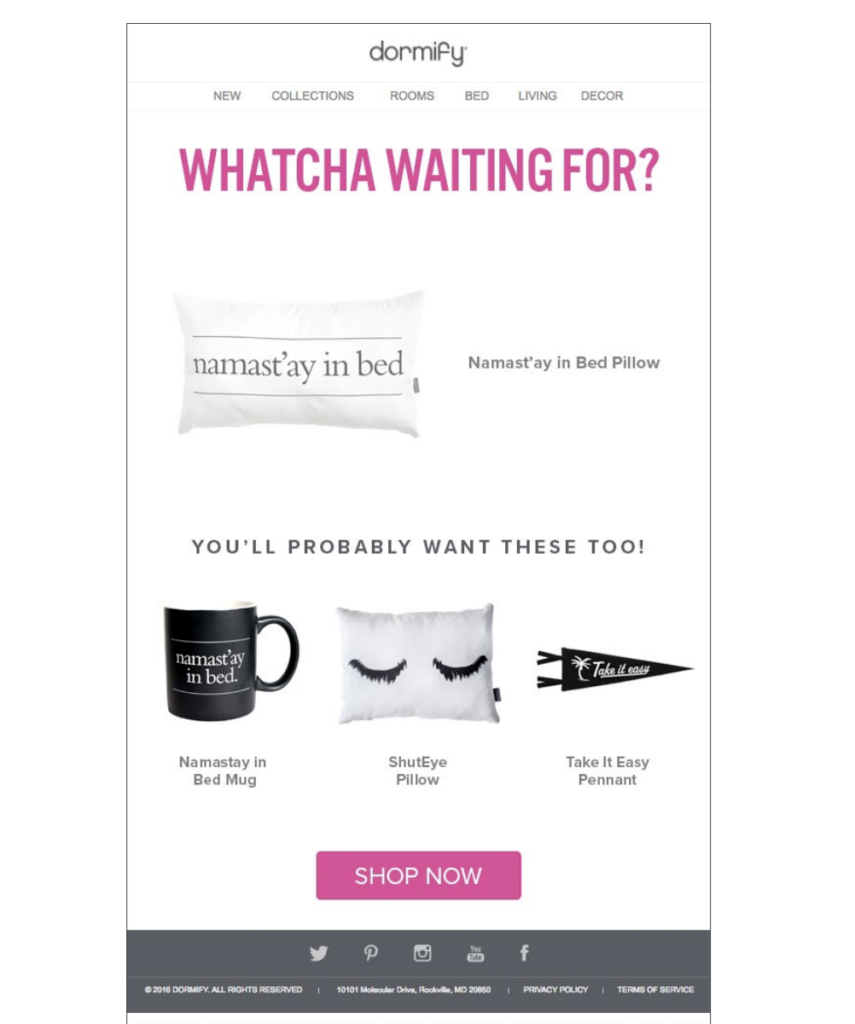
Abandoned cart emails don’t have to be heavy-handed or pushy. They can be friendly, funny, slightly sarcastic – whatever suits your brand’s tone of voice.
There are all sorts of reasons someone may have added something to their cart and then left your site. A small email reminder may be all they need to get back on track, and ready to click that Buy Now button.
Post-purchase emails

Most people think of post-purchase emails as the simple order confirmation email, the one that includes the order number, receipt, and tracking number. While that is a necessary email to send after someone purchases a product or service from you, it’s not the only kind of post-purchase.
Thank-yous (Abercrombie & Fitch opts for a very simple, minimal thank-you email), surveys, discounts, loyalty program offers, and more all fall under the heading of a post-purchase email.
Re-engagement emails
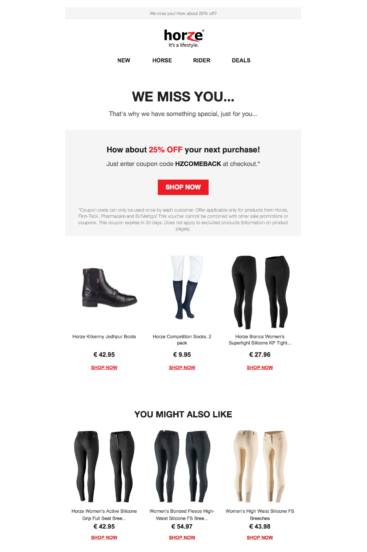
It’s hard to know why a customer becomes inactive. So why not ask? Horze, above, uses a re-engagement email to give customers 25% off their next purchase.
Creating a strong CTA to move to a preferences page allows you to showcase new offers and resources a lapsed customer may not know about, drawing them in to explore what else they might have missed since they’ve been gone.
Triggered emails
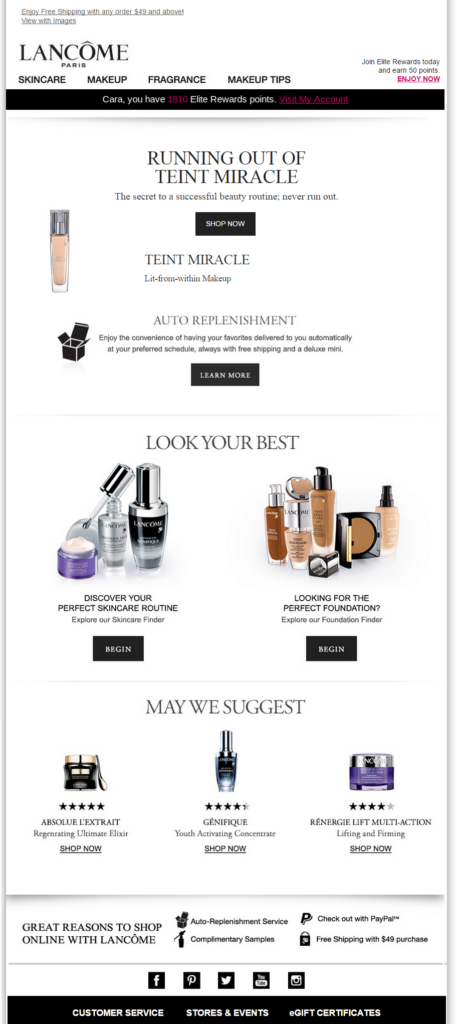
The above emails are all examples of triggered emails, messages sent at certain times based on certain customer behaviors. But they’re far from the only types of triggered emails you can set up.
Since they are fully automated, you can create a lot of different email triggers, from product replenishments and subscription renewals to anniversary or special occasion messages and discounts.
The above renewal email example from Lancome shows you how easy it is to combine a replenishment reminder with product recommendations.
Improve your messaging with behavioral email marketing
Behavioral email marketing is the key to unlocking the full power and potential of your email marketing campaigns. Why? Because it’s all about sending relevant emails that are triggered by shopper behaviors.
And with the right data analytics, you can create a fully realized image of who your customers are, what they need and at exactly the right time they are ready to make a purchase. Your email marketing will never miss the bull’s eye again.
Turn your retail and shopper data into email marketing gold with highly personalized messaging, using an email marketing platform flexible enough to let you stretch and grow with your customers. Let Bluecore help you create behavioral email marketing campaigns that take your brand to the next level.